
What is an NFC Card?
An NFC card is a physical card that contains a tiny microchip and a loop antenna. When a smartphone is held close to it, the card transmits data wirelessly to the phone in under 50 milliseconds. No app, no Bluetooth pairing, no camera required. Just a tap.
NFC stands for Near Field Communication. It operates at 13.56 MHz and works at a range of up to 4 centimetres. The technology is already in your pocket: every time you tap your Emirates NBD bank card at a checkout terminal or use your Nol card on the Dubai Metro, you are using the same NFC standard.
In business, NFC cards are used as digital business cards, hotel room keys, loyalty cards, Google review cards, digital menus, access passes, and WiFi connection cards. They look identical to a standard bank card but do something far more versatile when tapped.
Inside an NFC Card: The Anatomy
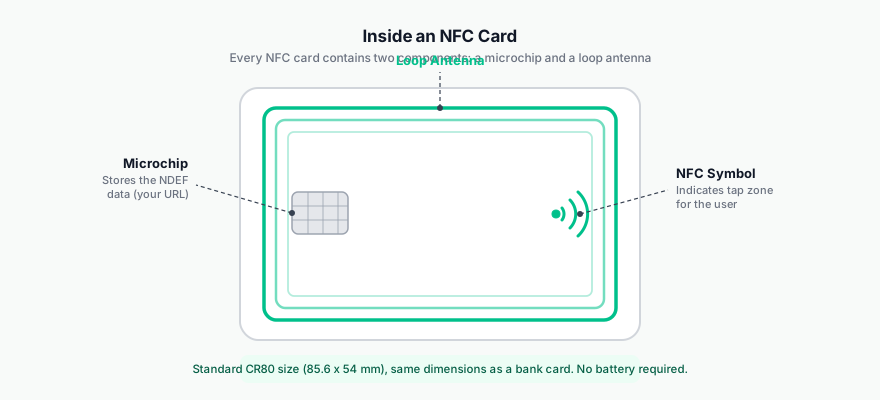
Every NFC card contains two functional components embedded inside the card body. Understanding what they do explains why NFC cards are so reliable and long-lasting.
The microchip
A tiny silicon chip, typically 1 to 2 mm square, stores the card's data in NDEF (NFC Data Exchange Format). For most business applications, this data is a URL: a link to your website, LinkedIn profile, Google review page, digital menu, or contact vCard. Common chips used in business NFC cards include the NTAG213 (144 bytes), NTAG215 (504 bytes), and NTAG216 (888 bytes). A full HTTPS web address with tracking parameters fits easily on the smallest chip.
The loop antenna
A flat coil of copper or aluminium wire runs around the inside perimeter of the card, just beneath the surface. This antenna receives the electromagnetic field generated by the reader (your phone), converts it into the electrical current needed to power the chip, and then broadcasts the chip's stored data back. The antenna is the reason NFC cards need no battery: they harvest power from the phone's own NFC field.
The NFC symbol
Most NFC cards display the universal NFC logo on the surface: four curved lines resembling a WiFi symbol rotated 90 degrees. This tells users where to tap their phone. It is printed, not functional.
Key fact
Passive NFC cards contain no battery and no moving parts. The chip is powered entirely by the electromagnetic field from the reading device. This is why NFC cards last 10 or more years and never need charging.
How an NFC Card Works: Step by Step
The whole exchange takes less than a second. Here is what happens at each step when someone taps a smartphone to an NFC business card:
- 1
Phone activates NFC
The smartphone's NFC radio switches on automatically when the screen is unlocked. On iOS (iPhone 7 and later), NFC scans are active without any settings change. On Android, NFC is enabled in Settings.
- 2
Electromagnetic field is generated
As the phone comes within approximately 4 cm of the NFC card, its antenna generates an alternating electromagnetic field at 13.56 MHz. This field radiates outward from the phone's NFC chip, which is typically located near the top-rear of the device.
- 3
Antenna receives energy
The card's loop antenna picks up the electromagnetic field. The field induces an alternating current in the antenna coil. This tiny current, a few milliamps, is enough to power the NFC chip.
- 4
Chip reads and responds
The powered chip accesses its stored NDEF data (your URL or contact record) and modulates the electromagnetic field to encode that data. This modulation is detected by the phone's NFC reader.
- 5
Phone decodes and acts
The phone's NFC controller decodes the modulated signal and extracts the NDEF record. If it is a URL, the phone opens it in the browser automatically. If it is a vCard, the Contacts app opens. The entire process takes 20 to 50 milliseconds.
Types of NFC Cards in Dubai
NFC cards come in many formats, each designed for a specific business application. All share the same underlying technology but differ in what they link to, how they are finished, and what material they are made from. If you are new to NFC, start with our guide to how NFC works before diving into card types.
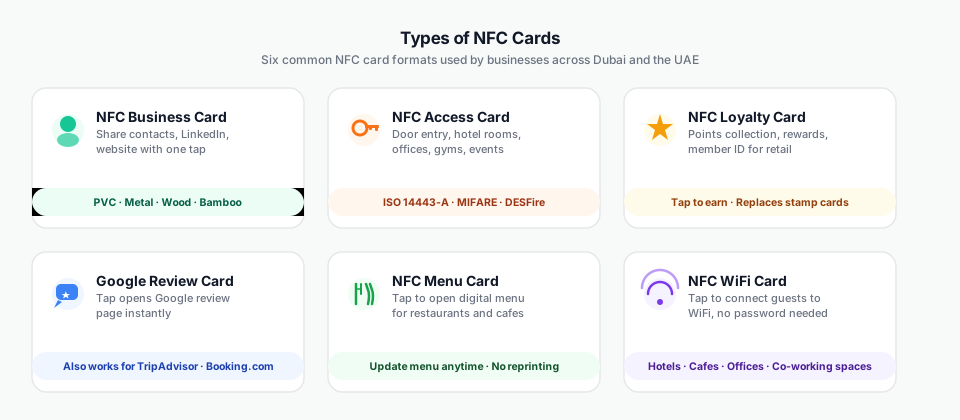
The most common NFC card in Dubai. A business card-sized card that, when tapped, opens your digital profile: LinkedIn, website, WhatsApp, contact vCard, portfolio, or any URL. Available in PVC, metal (stainless steel or black), eco-wood, and bamboo finishes. A single metal NFC card replaces hundreds of paper cards and makes a far stronger impression at networking events.
Used for door entry systems, hotel room keys, gym memberships, event access, and office security passes. These cards typically use MIFARE Classic or DESFire chips with encrypted sector data rather than an open URL. Most UAE hotel developments built since 2018 use NFC access cards rather than magnetic stripe keys.
Replace paper stamp cards in retail, coffee shops, and salons. The customer taps to log their visit or accumulate points, with data linked to a backend loyalty system. No app required if the card links to a mobile-optimised web loyalty platform. Gold and jewellery retailers across Dubai use NFC loyalty cards to streamline VIP customer management.
Pre-programmed to open your Google Business review page the moment a customer taps. No search, no navigation, no friction. Businesses place these at reception desks, on tables, and near checkout. The result is a significant increase in review volume, since the barrier to leaving a review drops to a single tap.
Card-sized NFC tags placed at restaurant tables that open a digital menu when tapped. No QR code scanning, no PDF download. The menu is a live web page, so the restaurant can update pricing, items, and daily specials without reprinting anything. Widely adopted across Dubai's restaurant scene after Expo 2020.
Tap to connect guests to WiFi without sharing a password verbally or on a printed sign. The card triggers an automatic connection prompt on the guest's phone. Used in hotel rooms, cafe guest areas, co-working spaces, and office reception areas across the UAE.
NFC Cards vs Paper Business Cards vs QR Code Cards
When businesses switch to NFC, the comparison with paper cards and QR codes is the first question they ask. Here is an honest side-by-side:
| Feature | NFC Card | Paper Card | QR Code Card |
|---|---|---|---|
| Sharing speed | Under 1 second | Immediate (hand over) | 3 to 5 seconds (focus, scan) |
| Requires phone action? | Just hold near card | None | Open camera, aim, wait |
| Works in direct sunlight? | Yes | Yes | Sometimes unreliable |
| Updateable after printing? | Yes (with redirect URL) | No | No (reprinting needed) |
| Durability | 10 or more years | Gets worn, bent, lost | Print fades or gets scratched |
| Environmental impact | One card, reused forever | Single use, discarded | Single use, discarded |
| First impression | Premium, memorable | Standard | Functional, not impressive |
| Cost per card | Higher upfront, zero ongoing | Low upfront, recurring | Low upfront, recurring |
Paper cards still have a place in mass-distribution contexts (trade show giveaways, flyers). But for professional networking in Dubai, where first impressions carry significant weight, an NFC metal card that transfers all your details with a tap is a measurable competitive advantage.
What Can an NFC Card Link To?
An NFC card can link to anything with a URL. Here are the most commonly used destinations for UAE businesses:
Contact vCard
Opens the Save Contact prompt on the phone with your full details pre-filled.
LinkedIn profile
Opens your LinkedIn page directly, ready to connect.
Website or portfolio
Opens any URL: company site, personal portfolio, product page.
Google review page
Opens your Google Business review submission page.
WhatsApp chat
Opens a WhatsApp conversation with your number, pre-loaded.
Instagram / social
Opens your Instagram, Facebook, TikTok, or any social profile.
Digital menu
Opens a live restaurant or cafe menu hosted online.
Booking page
Opens Calendly, Fresha, or any booking system.
Payment link
Opens a payment page or tip link for hospitality staff.
WiFi connection
Triggers automatic WiFi login without entering a password.
If you programme the card with a redirect URL (rather than writing the destination directly to the chip), you can change the destination any time from a web dashboard. The physical card never needs reprinting.
How to Choose the Right NFC Card for Your Business
Not all NFC cards are the same. The right choice depends on your use case, brand positioning, and how many people will use it.
Material
PVC cards are affordable, waterproof, and the most common. They are ideal for high-volume orders, loyalty cards, and menu cards. Metal NFC cards (brushed steel, black steel, gold finish) are premium business cards used by executives, consultants, and luxury brands. Eco-wood and bamboo cards are popular with sustainability-focused businesses. For access control, standard white PVC is typically used regardless of brand.
Chip type
For business cards, review stands, menu cards, and WiFi cards, the NTAG213 chip is the standard choice. It holds enough data for any URL and is compatible with all NFC-capable smartphones. For access control and loyalty systems that require encrypted data, MIFARE Classic or MIFARE DESFire chips are used. Your supplier should specify the chip type in the product description.
Programmable vs fixed
If you want to update the card's destination in the future (e.g., change your website URL, update a menu, switch your review platform), order cards programmed with a redirect URL. If the destination is permanent (an access control system, a fixed loyalty database), a directly-written chip is fine. SouqNFC can supply either configuration.
Quantity
NFC business cards for individual professionals are typically ordered in quantities of 10 to 100. Restaurant menu cards and hotel access cards are ordered in quantities of 50 to 500 or more. Volume pricing drops significantly: from AED 8 per piece at small quantities to AED 1 to 2 per piece at scale.
Print and branding
Full-colour custom printing is available on PVC and eco-material cards. Metal cards are typically laser-engraved or printed with a UV-resistant overlay. Provide print-ready artwork with bleed, and your supplier will proof it before production. At SouqNFC, branded cards include a free design consultation with your order.
Frequently Asked Questions
Do NFC cards require an app or internet connection?
No. NFC is built into modern smartphones. The recipient simply holds their phone near the card and the content opens automatically. No app, no account, and no internet connection is required by the card itself. The URL it opens will need an internet connection to load, just like any web page.
Can I change what an NFC card links to after I receive it?
Yes, if the card is programmed with a redirect URL. SouqNFC can programme your cards so you can update the destination any time from a simple web interface, without reprinting. Cards can also be locked permanently for applications like access control where the data should not change.
How long does an NFC card last?
Passive NFC cards have no battery or moving parts. The chip is rated for 100,000 or more read cycles and a 10-plus year lifespan. PVC cards are fully waterproof and wallet-safe. Metal NFC cards are rated for decades of daily use and will outlast any paper business card.
What is the difference between NFC and RFID?
NFC is a specific subset of RFID (Radio Frequency Identification). NFC operates at 13.56 MHz, at a range of up to 4 cm, and follows ISO 18092 and ISO 14443 standards. All NFC devices are technically RFID devices, but not all RFID devices support NFC. High-frequency RFID cards used in logistics (at 13.56 MHz) are NFC-compatible, while UHF RFID used in inventory systems (at 860 to 960 MHz) is not.
How much do NFC cards cost in Dubai?
Standard PVC NFC business cards start from around AED 1 per piece at volume, with branded printed cards typically ranging from AED 3 to 8 per piece. Metal NFC cards start from around AED 20 to 40 per piece. Contact SouqNFC for a tailored quote based on your quantity, material, and design requirements.
Do NFC cards work with all smartphones?
All iPhones from iPhone 7 (2016) onward read NFC tags natively, with no settings change needed. On Android, NFC has been standard on virtually all mid-range and flagship devices since 2016. With the UAE having one of the highest smartphone penetration rates globally and fast upgrade cycles, NFC compatibility is effectively universal for business use.
About the author
Sarah WhitmoreNFC Solutions Specialist at SouqNFC
Sarah Whitmore is an NFC solutions specialist and contributor writer at SouqNFC, with 3 or more years of experience in customised NFC products for B2B brands. She writes about smart branding, interactive business tools, and how companies can use NFC technology to improve customer engagement.
Order NFC Cards in Dubai
Get Custom NFC Cards for Your Business
SouqNFC supplies fully branded NFC business cards, loyalty cards, review cards, and access cards. Programmed and delivered across the UAE.