
Walk into almost any Dubai restaurant, hotel lobby, or trade show stand today and you will find either an NFC tap point or a QR code. Both technologies do essentially the same job: they connect a physical object to a digital destination. But they do it in very different ways, and for UAE businesses, the choice between them has real consequences for customer experience, conversion rates, and brand perception. If you are new to NFC, our guide to how NFC works is a good starting point. And if you are also considering Bluetooth, see our NFC vs Bluetooth comparison.
This guide compares NFC and QR codes head-to-head across every dimension that matters for business use in the UAE, from speed and reliability to cost and security, and tells you clearly which to choose for each use case.
The Core Difference: One Tap vs One Scan
The fundamental difference between NFC and QR codes is what the user has to do.
With NFC
The user holds their phone within 4 cm of the NFC tag. Their phone detects the tag automatically and opens the linked content. No camera. No app. No aiming. No waiting. Under 50 milliseconds start to finish.
With QR Code
The user opens their camera app (or a QR scanner app on older devices), aims it at the code, holds it steady while it focuses, waits for the code to register, then taps the notification that appears. In poor lighting or with a worn code, this can fail entirely.
That difference in friction is not trivial. In customer-facing settings, every additional step the user has to take reduces the likelihood they complete the action. This is why NFC review stands consistently outperform QR code equivalents in Google review generation rates.
How NFC and QR Codes Actually Work
How NFC works
NFC (Near Field Communication) operates at 13.56 MHz using electromagnetic induction. A passive NFC tag (the card or sticker) contains a microchip and a loop antenna. When an NFC-enabled phone comes within about 4 cm, the phone generates an electromagnetic field that powers the chip. The chip broadcasts its stored data (typically a URL) back to the phone in under 50 milliseconds. The phone opens the URL automatically. No battery in the tag. No internet required by the tag itself.
How QR codes work
A QR code is a two-dimensional barcode that encodes data (typically a URL) as a pattern of black and white squares. A smartphone camera decodes the pattern using image recognition software. The phone processes the image, extracts the URL, and opens it. The entire process depends on camera clarity, lighting conditions, code print quality, and the angle of the camera. QR codes contain no electronics: they are purely printed.
Head-to-Head Comparison
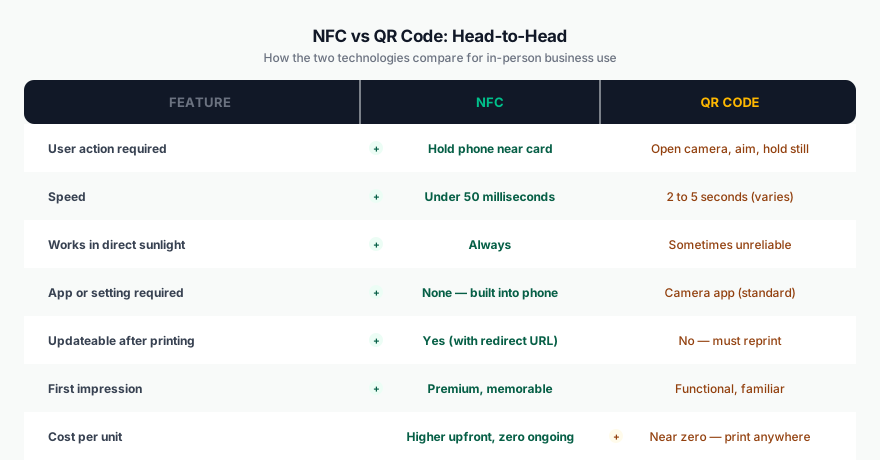
On most metrics that matter for in-person business use, NFC wins clearly. The one area where QR codes have a genuine advantage is upfront cost: printing a QR code on a business card or flyer adds essentially nothing to the cost, while an NFC chip adds a few dirhams per unit. For mass-printed materials at volume, that cost difference is meaningful.
Where NFC Wins
Speed and conversion
Every second of additional friction in a customer interaction reduces conversion. NFC reduces the action to a single physical gesture. For Google review collection, where the window of opportunity is typically 30 to 60 seconds after a positive customer experience, speed is everything. A tap takes less than a second. A QR scan takes 5 to 10 seconds under real-world conditions including the time to open the camera.
Reliability in UAE conditions
Dubai and UAE businesses operate in environments where QR codes struggle: outdoor venues in intense sunlight, dimly lit restaurants and lounges, pool and beach areas with glare, and dusty or humid conditions that damage printed codes. NFC is entirely indifferent to lighting, weather, and surface condition. The tap works in complete darkness. A QR code in direct midday Dubai sunlight can be unreadable.
Premium brand positioning
A metal NFC business card from a consultant at DIFC leaves an impression that a paper card with a QR code cannot match. The tap is seamless, modern, and slightly surprising to people who have not encountered it before. In Dubai's hyper-competitive professional services market, that first impression has real commercial value. Many C-suite executives and agency founders in Dubai now carry metal NFC cards as a deliberate brand signal.
Hospitality and table settings
Restaurants and cafes across Dubai face a real problem with table QR codes: they get dirty, damaged, or scratched, making them unscannable. They can also be confused with other printed materials at the table. An NFC table stand or embedded NFC spot is invisible until tapped, always works, and cannot be damaged by a spilled drink. Several well-known Dubai restaurant groups have replaced QR menus with NFC entirely.
Security
QR code fraud (known as quishing) is a growing problem globally. Attackers place a fraudulent QR sticker over a legitimate one in public spaces. Victims scan without realising the code has been swapped. NFC tags can be locked (made read-only) and cannot be visually impersonated. For access control, payment, and authentication applications, NFC is significantly more secure.
Where QR Codes Still Make Sense
QR codes are not obsolete. There are specific contexts where they remain the better choice, or at least a sensible complement to NFC.
Mass printed materials
If you are printing 50,000 flyers, packaging inserts, or event posters, adding an NFC chip is not practical. QR codes print for free alongside the other artwork. For one-directional marketing at scale (billboards, newspaper ads, product packaging), QR codes are the right tool.
Outdoor signage and large formats
NFC has a maximum read range of about 4 cm. A billboard or a sign mounted 30 cm from the pavement cannot be tapped. QR codes can be read from a metre or more and scale to any print size. For large-format outdoor advertising, QR codes are the only option.
Temporary or high-churn campaigns
If you need a contactless touch point for a one-week promotional campaign and cost is the main factor, a printed QR code on a tent card is faster to produce and costs nothing extra. NFC makes more sense for permanent or semi-permanent use points where the one-time investment is recovered over time.
Digital-only contexts
On a website, a PDF, or an email, you cannot use NFC. QR codes work anywhere a camera can see them, including screens. If you need to bridge digital content to a mobile action, QR codes are the only option.
Real-World UAE Business Examples
The debate between NFC and QR codes is not theoretical in the UAE. Businesses here have tested both and made clear-eyed decisions based on results.
Dubai restaurants
Several casual dining groups in JBR and Dubai Marina piloted QR table tents for Google review collection in 2023, then switched to NFC stands in 2024 after measuring the difference in review submission rates. The frictionless tap proved materially better at converting a satisfied diner into a reviewer, particularly for older customers who found the camera-aim process frustrating.
GITEX exhibitors
At GITEX Technology Week, tech companies increasingly hand out NFC business cards rather than printing QR codes on paper cards. The tap experience is a product demonstration in itself. For a company selling digital transformation services, handing someone an NFC card and watching them tap-and-connect is a far more compelling live proof point than a printed QR code.
Hotel chains
UAE hotel groups use both in different contexts: NFC for room keys, in-room information cards, and reception review stands; QR codes on printed collateral, laundry bags, and external marketing materials. This hybrid approach is sensible and common: NFC for high-touch in-person moments, QR for mass-printed items.
Real estate agencies
Property developers and agencies in Dubai use NFC-enabled property brochures and show unit displays. Visitors tap a tag on a model apartment to receive the full floor plan, pricing, and payment plan on their phone. The experience is cleaner than pointing at a QR code on a wall panel and feels appropriate for high-value transactions.
Which Should Your Business Choose?
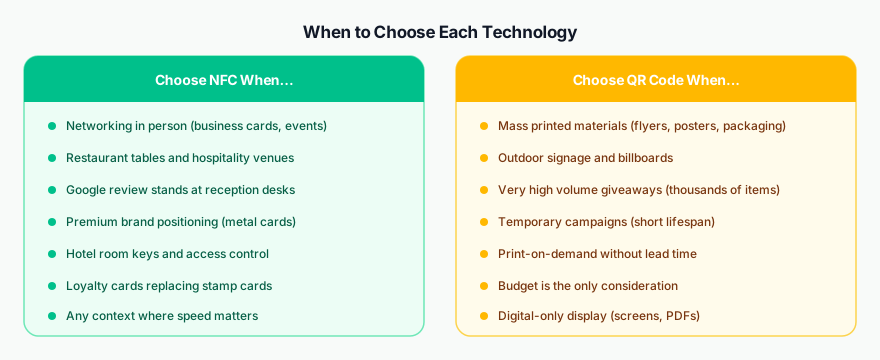
The honest answer for most UAE businesses is: use both, in the right places.
NFC is the better choice for any in-person, high-value, or repeated customer touchpoint: business cards, restaurant table stands, hotel reception desks, retail loyalty cards, event access. The one-time cost is recovered quickly through better conversion and a better customer experience.
QR codes remain practical for mass printed materials, outdoor signage, digital surfaces, and anywhere NFC is physically impractical.
The practical rule
If the same person will interact with the touchpoint more than once, or if conversion rate matters, use NFC. If the touchpoint is printed at mass scale or displayed at a distance, use QR. For most UAE businesses, the Google review stand, the business card, and the table menu are NFC. The flyer, the billboard, and the packaging are QR.
Frequently Asked Questions
Is NFC faster than QR codes?
Yes. NFC transfers data in under 50 milliseconds with no user action beyond holding a phone close. QR codes require opening the camera app, aiming, focusing, and waiting for the scan to register, typically 2 to 5 seconds under good conditions and longer in poor lighting or with a worn code.
Can all phones in the UAE read NFC?
All iPhones from iPhone 7 (2016) onward and virtually all Android phones since 2016 read NFC natively with no app required. Given UAE smartphone penetration rates and upgrade cycles, NFC compatibility is effectively universal for business use.
Are QR codes free to create?
Basic static QR codes are free to generate. However, static QR codes cannot be updated after printing. Dynamic QR codes that allow URL changes require a paid subscription, typically USD 5 to 30 per month. An NFC card with a redirect URL has a one-time cost and no ongoing fee.
Which is more secure, NFC or QR codes?
NFC is significantly more secure for in-person use. Its 4 cm range makes remote interception essentially impossible. QR codes can be physically swapped or overlaid with fraudulent codes in public spaces, a known attack vector called QR phishing or quishing. For business card and review stand use, both carry low practical risk, but NFC cannot be tampered with visually.
Which should a Dubai restaurant use: NFC stands or QR codes?
For Google review generation and digital menus at tables, NFC stands outperform QR codes in conversion rate. The tap is faster, works in dim restaurant lighting where cameras struggle, and feels more premium. Many Dubai restaurants use both: NFC stands at high-value tables and QR codes on printed receipts for broader coverage.
About the author
Daniel KareemNFC Product Consultant at SouqNFC
Daniel Kareem is a contributor writer and NFC product consultant at SouqNFC with 3 or more years of experience in the NFC industry. He focuses on practical business applications of NFC technology, including networking tools, smart tags, and contactless customer solutions.
Ready to switch to NFC?
Get NFC Products for Your UAE Business
SouqNFC supplies NFC business cards, Google review stands, table menus, stickers, and more. Programmed and delivered across Dubai and the UAE.