
NFC and Bluetooth are both wireless technologies built into almost every smartphone sold today. Both transfer data without a cable. Both are used in business settings across Dubai and the UAE. And both are frequently confused with each other.
They are not the same technology, and they are not interchangeable. They solve different problems at different ranges with different trade-offs. If you are new to NFC, read our complete guide to how NFC works first. This article focuses on how the two technologies compare and when to choose each.
The Short Answer
NFC
Works within 4 cm. Triggers a single instant action with no setup. No pairing, no app, no battery in the tag. Best for tap-to-connect moments: NFC business cards, Google review stands, digital menus, WiFi cards.
Bluetooth
Works up to 100 metres. Maintains an ongoing connection after an initial pairing step. Requires a battery on both devices. Best for sustained connections: audio streaming, IoT sensors, fitness trackers, proximity beacons.
For customer-facing touchpoints in UAE businesses, NFC is almost always the right choice. For infrastructure and connected device applications, Bluetooth typically wins. Most businesses that use both are using them for different purposes in the same environment.
How NFC Works
NFC (Near Field Communication) operates at 13.56 MHz using electromagnetic induction. A passive NFC tag contains a microchip and a tiny antenna loop. It has no battery and no active components.
When an NFC-enabled phone comes within approximately 4 cm of the tag, the phone generates a small electromagnetic field. This field powers the chip wirelessly. The chip transmits its stored data (typically a URL) back to the phone in under 50 milliseconds. The phone processes the data and takes the programmed action: opening a website, downloading a contact card, connecting to WiFi, or loading a Google review page.
The key word is passive. An NFC business card or Google review stand contains no battery, no charging port, and no active electronics. It powers itself from your phone's field for the fraction of a second it takes to transmit its data. This is why NFC products last indefinitely with no maintenance.
NFC is a descendant of RFID technology but designed specifically for two-way communication at very close range. The 4 cm limit is a physical consequence of how the electromagnetic field works, not an artificial restriction.
How Bluetooth Works
Bluetooth operates at 2.4 GHz radio frequency using active radio transmission. Unlike NFC, both devices in a Bluetooth connection must be powered and actively broadcasting. The initial connection requires a pairing step where the two devices exchange credentials and agree to trust each other.
Classic Bluetooth (used for audio and file transfer) typically reaches 10 to 30 metres. Bluetooth Low Energy (BLE), the modern variant used in IoT and proximity applications, can reach up to 100 metres with low power consumption.
Once paired, Bluetooth maintains a persistent connection that allows continuous data transfer in both directions. This is what makes it suitable for audio streaming, wearable sensors, and ongoing device control. The trade-off is that it requires a battery, takes several seconds to connect, and the connection can be intercepted by other devices within radio range.
Head-to-Head Comparison
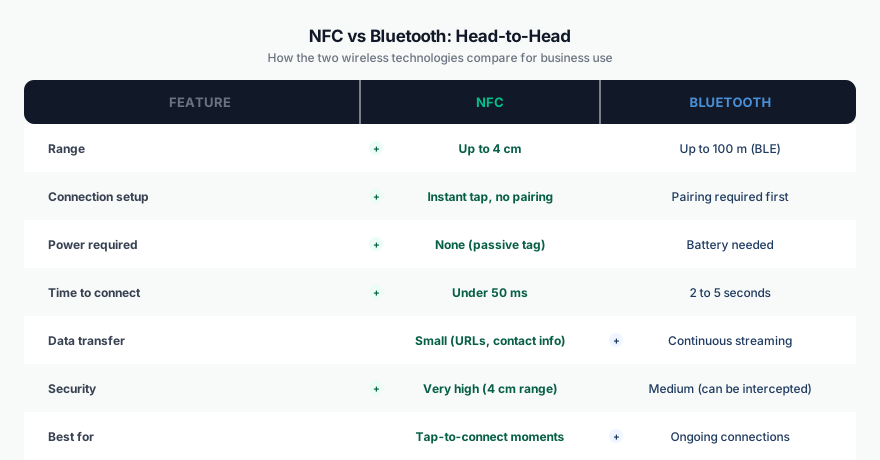
The pattern is clear: NFC wins on simplicity, speed, and security for short-range one-time interactions. Bluetooth wins on range and sustained data throughput. These are complementary strengths, not competing ones.
Where NFC Wins
Customer touchpoints that need to just work
NFC requires nothing from the customer except holding their phone near the tag. No app to open, no Bluetooth to enable, no pairing to complete, no camera to aim. A customer at a restaurant table taps the NFC stand and the Google review page opens. That is one physical action and one outcome. Every additional step Bluetooth would require reduces the likelihood the customer completes the action.
Business cards and professional networking
At a business meeting in Dubai, tapping phones to share contact details is seamless with NFC and awkward with Bluetooth. NFC transfers a vCard or opens a LinkedIn profile in under a second. A Bluetooth transfer would require both parties to open their settings, enable Bluetooth, find each other's device, pair, accept permissions, and navigate a file transfer. NFC wins this context entirely.
Products that cannot have batteries
An NFC sticker on a product, a tag embedded in a hotel key card, or an NFC business card requires no power source. It works permanently without charging or maintenance. Any equivalent Bluetooth device would need a battery, adding cost, weight, maintenance, and eventual failure when the battery dies.
Security for in-person transactions
The 4 cm range of NFC is a security feature. An attacker cannot read your NFC card from across the room. Contactless payment systems (Apple Pay, Google Pay) use NFC for exactly this reason. For access control, loyalty cards, and any scenario where a third party intercepting the signal would be a problem, NFC is significantly more secure.
Where Bluetooth Wins
Audio and media streaming
Bluetooth is the standard for wireless audio. Speakers, headphones, car systems, and PA equipment all use Bluetooth because it can stream continuous, high-quality audio over a useful distance. NFC cannot stream audio.
IoT and sensor networks
Hotels, retail stores, and smart buildings use Bluetooth Low Energy sensors to monitor temperature, occupancy, foot traffic, and energy use across large spaces. BLE devices can run for years on a coin battery and communicate with a central hub up to 100 metres away.
Proximity beacons for location-based marketing
Retail stores and shopping malls use BLE beacons to send push notifications to customers who have the store's app installed and are within range. This is a Bluetooth use case that NFC cannot replicate because it requires the signal to reach the customer at distance, before they tap anything.
Peripherals and ongoing device control
Keyboards, mice, game controllers, barcode scanners, and point-of-sale peripherals use Bluetooth because they need a persistent, two-way connection. NFC does not maintain a connection after the initial data exchange.
When Businesses Use Both
In many UAE business environments, NFC and Bluetooth coexist because they serve different functions. They are not competing; they are complementary.
Hotel example
A hotel in Dubai Marina uses NFC key cards for room access and NFC table cards in the restaurant for the digital menu. The same hotel uses Bluetooth speakers in guest rooms, BLE occupancy sensors in common areas, and Bluetooth-connected POS terminals at the front desk. NFC handles the customer-facing tap moments; Bluetooth handles the infrastructure.
Retail example
A clothing store in Mall of the Emirates uses NFC loyalty cards so customers can tap at the till to earn points without needing an app. The same store uses BLE beacons to send app notifications to customers who opted in when they enter the store. The tap is NFC; the ambient push is Bluetooth.
Events example
A corporate event at DIFC uses NFC wristbands for cashless payments and access control at different venue zones. The same event uses Bluetooth audio equipment for the sound system and BLE-enabled badge scanners for lead capture at exhibitor stands. Different tools for different jobs in the same environment.
Which Should You Choose?
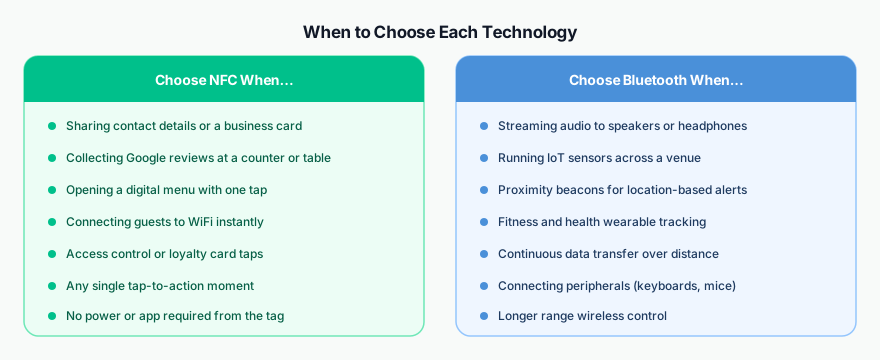
If you are a UAE business looking to add a contactless touchpoint for customers, the answer is almost certainly NFC. NFC cards, Google review stands, digital menus, WiFi sharing cards, loyalty cards, and access cards are all NFC applications. You may also want to read our NFC vs QR Code comparison if you are deciding between the two most common contactless options. They are passive, require no setup from the customer, and work instantly with any modern smartphone.
The practical rule
If the interaction is a single tap that triggers one action, use NFC. If the interaction requires a sustained connection between two powered devices over a useful distance, use Bluetooth. If you need both, use both. They were designed to coexist.
Frequently Asked Questions
What is the main difference between NFC and Bluetooth?
The main difference is range and intent. NFC works within 4 cm and triggers a single instant action with no setup. Bluetooth works up to 100 metres and maintains an ongoing connection for continuous data transfer. NFC is for tap-to-connect moments; Bluetooth is for sustained connections.
Does NFC require pairing like Bluetooth?
No. NFC requires no pairing, no app, and no setup from the user. You hold your phone near the NFC tag and the action happens instantly. Bluetooth requires an initial pairing step and both devices must have Bluetooth enabled and actively searching.
Can NFC replace Bluetooth?
For most business card and customer touchpoint applications in the UAE, NFC is the better choice. However, NFC cannot replace Bluetooth for applications that need sustained connections over distance, such as audio streaming, IoT sensor networks, or proximity beacons. The two technologies solve different problems and are often used together.
Is NFC or Bluetooth more secure?
NFC is more secure for in-person interactions because its 4 cm range makes remote interception essentially impossible. Bluetooth connections, especially over longer ranges, can be intercepted by attackers within radio range. For contactless payments and sensitive data exchanges, NFC is the preferred standard.
Which do UAE businesses use more, NFC or Bluetooth?
For customer-facing touchpoints like business cards, Google review stands, digital menus, and loyalty cards, UAE businesses predominantly use NFC. Bluetooth is used more in infrastructure: speaker systems, venue sensors, fitness equipment, and location beacons. The two technologies are complementary in most business environments.
About the author
Omar Al NuaimiNFC Solutions Specialist at SouqNFC
Omar Al Nuaimi is an NFC Solutions Specialist at SouqNFC with over 4 years of experience helping UAE businesses adopt NFC technology. He works directly with clients across Dubai, Sharjah, and Abu Dhabi to implement smart networking tools, contactless review systems, and custom-branded NFC products.
Ready to add NFC?
Get NFC Products for Your UAE Business
SouqNFC supplies NFC business cards, Google review stands, table menus, stickers, and more. Programmed and delivered across Dubai and the UAE.