
NFC Guides
NFC vs RFID: What is the Difference?
A delivery truck rolls into Jebel Ali Free Zone. Two technologies are running simultaneously. A UHF RFID reader mounted on the entry gate scans pallets from three metres away and logs the cargo. In the driver's pocket, his phone reads an NFC tagon the gate pass and loads the site safety briefing. Same principle. Completely different use cases. Both listed as “RFID” on spec sheets.
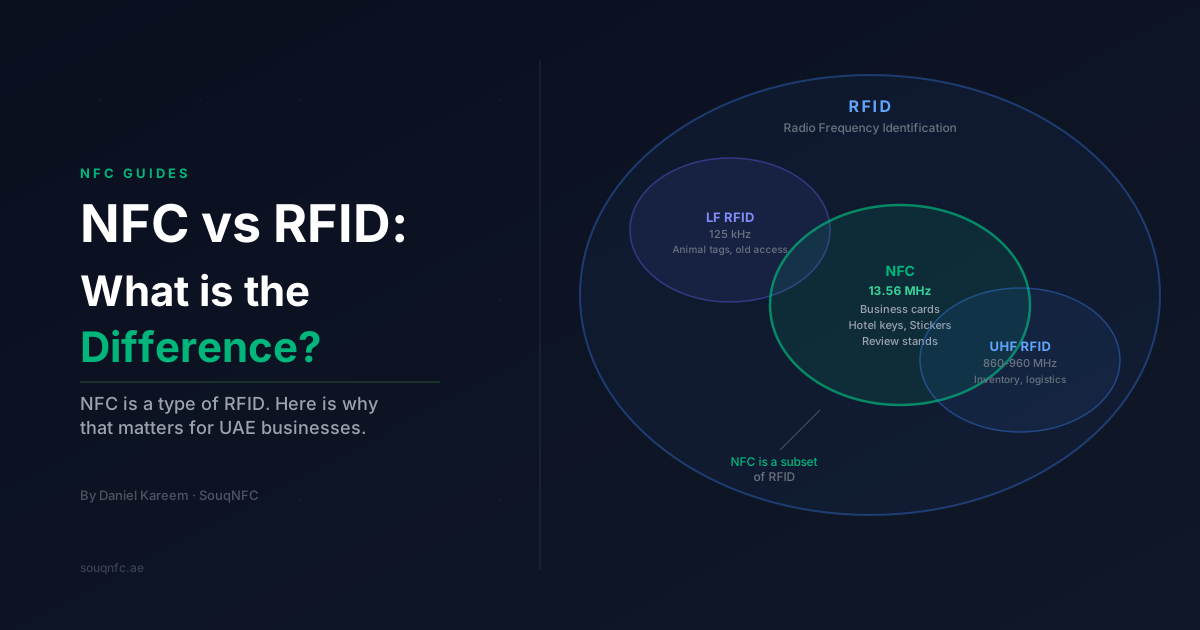
Most articles on NFC vs RFID frame them as competing technologies. That framing is wrong. NFC is a specific type of RFID operating at 13.56 MHz with a standardised protocol designed to work with smartphones. Understanding the relationship properly will save you from ordering the wrong technology for your business and wondering why it does not do what you expected.
According to IDTechEx market research, over 40 billion RFID tags were shipped globally in 2023 across all frequency bands. The vast majority were UHF tags for logistics. A fast-growing share were NFC tags used in consumer products, business cards, and payment systems. They are both “RFID” but almost nothing about their practical use overlaps.
Are NFC and RFID the same technology?
NFC is a type of RFID. RFID is the umbrella term for all radio-frequency identification technologies. NFC sits within that umbrella at 13.56 MHz, following the ISO 18092 standard and designed to communicate with smartphones and smartcard readers at under 4 cm.
Think of it this way. RFID is to NFC as “vehicle” is to “car.” All NFC is RFID. Not all RFID is NFC. When someone asks whether they need NFC or RFID, what they usually mean is: do I need NFC (phone-readable, short range) or UHF RFID (long range, dedicated readers, bulk scanning)?
The confusion comes from how suppliers market their products. NFC suppliers call it “NFC.” Warehouse and logistics suppliers call their products “RFID.” Both are right. But the technologies serve entirely different use cases, which is what actually matters when you are choosing.
How does RFID work at different frequency bands?
RFID operates across three main frequency bands: low frequency (LF) at 125-134 kHz for short-range animal and legacy access tags, high frequency (HF) at 13.56 MHz where NFC lives, and ultra-high frequency (UHF) at 860-960 MHz for long-range logistics scanning.
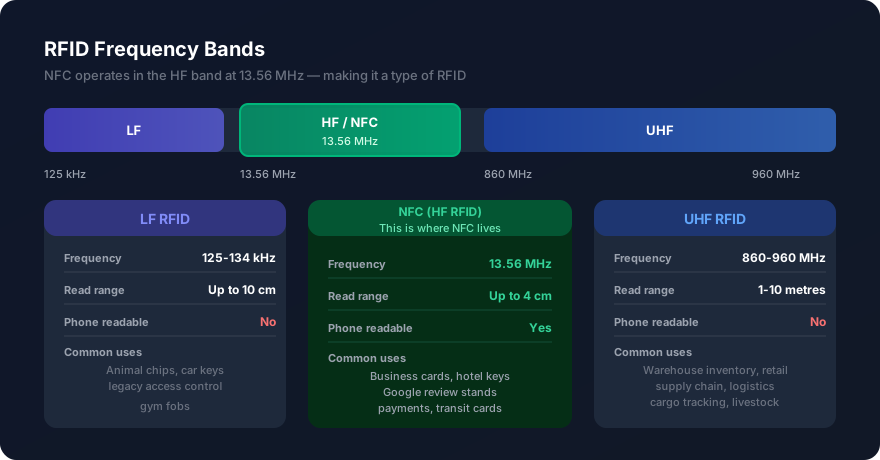
Each frequency band behaves differently because of physics. Lower frequencies penetrate materials well but have short range and slow data transfer. Higher frequencies can reach further and handle more data per second, but they struggle with water and metal (which is why UHF RFID readers need careful positioning in warehouses with liquids or metallic packaging).
LF RFID: 125-134 kHz
Low-frequency RFID is the oldest mainstream variant. It is read-only in most implementations, with a range of around 10 cm. You encounter it in pet microchips, livestock ear tags, and some older vehicle immobilisers. It is largely legacy technology at this point. Smartphones do not read it.
HF RFID and NFC: 13.56 MHz
High-frequency RFID is where NFC lives. The 13.56 MHz band also hosts other standards such as ISO 15693 (used for library systems and some industrial tags) and ISO 14443 (used for transit cards, hotel keys, and NFC products). NFC is a specific protocol within this band that adds two-way communication, smartphone compatibility, and a defined set of data formats called NDEF records.
Dubai's Nol card is HF RFID using the MIFARE standard, which is part of the ISO 14443 / NFC family. Your hotel room key in most Dubai hotels is almost certainly a MIFARE card. So are NFC business cards, Google review stands, and every other NFC product SouqNFC supplies.
UHF RFID: 860-960 MHz
Ultra-high frequency is what most people picture when they think “warehouse RFID.” Tags are cheap (sometimes under $0.05 each at volume), read range can reach 10 metres, and a single reader can log hundreds of tags per second. This is the technology behind retail inventory management, pallet tracking in logistics hubs, and pharmaceutical supply chain compliance. It requires dedicated readers and cannot be picked up by a smartphone.
What specifically makes NFC different from other RFID systems?
NFC differs from other RFID in four key ways: it works with smartphones without additional hardware, it supports two-way communication, it uses the NDEF data format for standardised content like URLs and contacts, and its 4 cm range makes it intentionally close-proximity.
The most commercially important difference is smartphone compatibility. Every iPhone since the 6s and virtually every Android device since 2015 has an NFC reader built in. When a customer taps an NFC sticker or card, no app is required, no reader hardware is needed on the business side, and no QR scan is involved. The phone reads the tag and acts on it immediately.
Two-way communication is less obvious but important for secure applications. Standard UHF and LF RFID is usually one-directional: the reader interrogates the tag and the tag responds. NFC can communicate in both directions, which enables payment processing, access control verification, and data writing back to the tag (for example, updating a tap counter or loyalty point balance).
For a deeper look at what happens inside an NFC chip during a tap, including chip types (NTAG213, NTAG216, MIFARE DESFire) and how NDEF records work, the NFC chip types and frequencies guide covers that in detail.
| Feature | NFC (HF RFID) | UHF RFID | LF RFID |
|---|---|---|---|
| Frequency | 13.56 MHz | 860-960 MHz | 125-134 kHz |
| Read range | Up to 4 cm | 1-10 metres | Up to 10 cm |
| Smartphone readable | Yes, built-in | No | No |
| Communication | Two-way | One-way (typical) | One-way |
| Tags per read | One at a time | Hundreds per second | One at a time |
| Data format | NDEF standard | EPC Gen2 / proprietary | Proprietary |
| Typical tag cost | AED 1-15 | Under AED 1 at volume | AED 2-10 |
| Reader hardware | Phone (built-in) | Required (AED 500-5,000+) | Required |
| Best for | Customer interactions | Logistics, inventory | Animal tags, vehicle |
Where does each technology appear in UAE businesses?
In the UAE, NFC appears wherever customers interact directly with a product: business cards, hotel keys, review stands, and payment terminals. UHF RFID appears behind the scenes in logistics hubs, warehouses, and retail stock management systems across Jebel Ali and Abu Dhabi industrial areas.
NFC in UAE businesses
- Hospitality and tourism: Hotels across Dubai and Abu Dhabi use MIFARE-based NFC access cards for room keys. The same card can be programmed to open the gym, pool gate, and minibar. Tap, done.
- Retail and restaurants: Businesses use NFC stickers on tables and counters to redirect customers to Google review pages, digital menus, or loyalty programmes without any app installation.
- Professional networking: At GITEX and business events, NFC business cards have replaced paper card exchanges. One tap shares a full digital profile: LinkedIn, website, contact details, and a portfolio link.
- Payments: Apple Pay, Google Pay, and contactless bank card payments all use NFC at 13.56 MHz. The same protocol behind a NFC business card is behind every tap-to-pay transaction at UAE checkouts.
UHF RFID in UAE businesses
- Logistics and ports: Jebel Ali Port is one of the largest UHF RFID deployments in the region. Container tracking, vehicle gate passes, and cargo manifest verification all run on UHF RFID infrastructure.
- Retail chains: Major UAE fashion and electronics retailers use UHF RFID for inventory management. Tags on garments and products are counted at stockroom entry points without staff touching individual items.
- Healthcare: Pharmaceutical manufacturers and hospital supply chains use UHF RFID to track medication batches and verify cold chain compliance, logging every movement automatically.
- Events and access control: Large venue security at Dubai World Trade Centre events uses UHF RFID wristbands for access gates, allowing thousands of simultaneous reads without bottlenecks.
Which technology does your UAE business actually need?
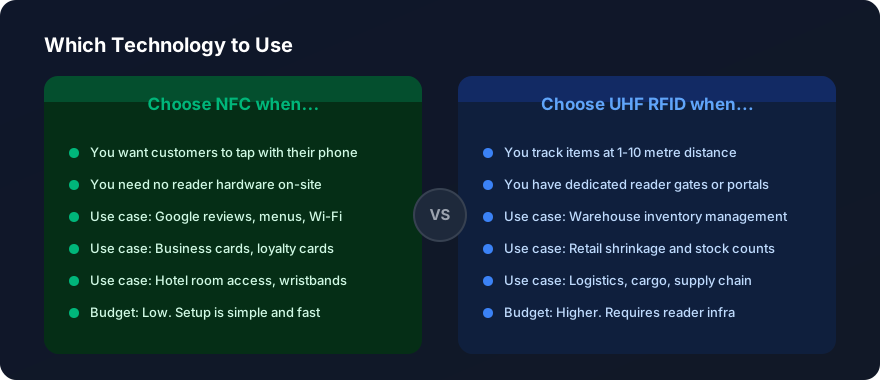
If your customers will interact with the tag using their smartphone, you need NFC. If you are tracking inventory or assets through space at scale, you need UHF RFID. The two technologies rarely compete for the same job in practice.
The most common source of confusion is the word “RFID” appearing in both contexts. A supplier quoting you RFID wristbands for a brand activation event at Dubai Frame is almost certainly offering NFC wristbands (13.56 MHz, phone-readable). A supplier quoting you RFID for warehouse inventory is almost certainly offering UHF RFID (860-960 MHz, reader hardware required). Always ask which frequency band.
For the vast majority of Dubai and UAE businesses, the question is really about NFC products: business cards, Google review stands, stickers, access cards, and loyalty cards. These are all NFC. All work with any modern smartphone. None require dedicated reader hardware on the customer side.
If you are genuinely evaluating a UHF RFID system for inventory or logistics, that is a different project with a different budget (reader hardware alone can cost AED 2,000-15,000 per installation point). The products SouqNFC supplies are all NFC products in the 13.56 MHz HF band, designed for direct customer interaction.
For background on how NFC works as a technology before comparing it to other wireless options, the complete NFC guide for UAE businesses covers the fundamentals. For a comparison with another short-range wireless standard, the NFC vs Bluetooth breakdown is worth reading alongside this post.
Frequently Asked Questions
Can a smartphone read RFID tags?
Most smartphones cannot read standard LF or UHF RFID tags. They only read NFC tags because NFC operates at 13.56 MHz, the frequency built into every modern smartphone. LF tags at 125 kHz and UHF tags at 860-960 MHz require separate reader hardware that phones do not include.
Is the Nol card NFC or RFID?
The Dubai Nol card uses MIFARE technology, which operates at 13.56 MHz and falls within the NFC and HF RFID family. It is technically contactless smartcard RFID. Most modern smartphones can detect Nol card data using their built-in NFC reader, though the RTA system controls what data is accessible to third-party apps.
Can you use NFC for inventory tracking?
NFC works for small-scale inventory where items are scanned one at a time at close range. For high-volume warehouse operations where dozens of items pass a gate point simultaneously, UHF RFID is far more practical. It reads at 1-10 metres and processes hundreds of tags per second, which NFC physically cannot do.
What is the difference between NFC and MIFARE?
MIFARE is a family of NFC chips made by NXP Semiconductors. It operates at 13.56 MHz within the NFC frequency band. MIFARE cards, including MIFARE Classic, MIFARE Plus, and MIFARE DESFire, are NFC chips with enhanced security features. MIFARE is to NFC what NTAG is to NFC: a specific chip brand within the broader NFC standard.
Why do UAE hotels use NFC rather than UHF RFID for room keys?
Hotel room keys need short-range precision. You tap at the door, not scan from across the corridor. NFC's 4 cm range is exactly right for that. UHF RFID at 1-10 metres would create security problems for room access, because a reader inside the room could potentially be triggered by someone walking past in the corridor.
Is NFC more secure than UHF RFID?
NFC is harder to intercept at a distance because the read range is limited to 4 cm. UHF RFID tags can theoretically be read from several metres away with a high-gain antenna, which raises concerns for certain secure applications. For standard business use cases like review stands and business cards, neither technology carries sensitive data that requires encryption.
Do NFC products in the UAE need any special licensing?
NFC operates at 13.56 MHz and is an unlicensed frequency in the UAE, consistent with global standards. No licensing is required to use NFC business cards, stickers, or Google review stands. UHF RFID commercial installations may have UAE Telecommunications and Digital Government Regulatory Authority (TDRA) compliance requirements depending on power output and application.
Ready to use NFC?
SouqNFC supplies NFC products for UAE businesses
NFC business cards, Google review stands, stickers, access cards, and more. All operating at 13.56 MHz and readable by any modern smartphone.
Get a quote