NFC Use Cases
NFC Business Cards for GITEX: What to Prepare
By day three of a major exhibition, the average stand visitor is carrying a wad of paper cards held together by a lanyard and a rubber band. Most of those cards never get entered into a CRM. They get emptied out of a jacket pocket a fortnight later, at which point nobody remembers which conversation went with which logo. Every exhibitor at every show knows this, and most of them print another thousand cards anyway.
GITEX is where that habit looks most out of place. It is a technology show, your visitors are technology buyers, and the moment you hand over a paper rectangle at a stand demonstrating AI infrastructure, you have said something about your company that you did not intend to say.
This guide covers the practical preparation: the dates that changed this year, when to place the order, how many cards a stand team actually needs, what the card should open, and what to do on the floor and in the week afterwards. It is written for exhibitors, but most of it applies just as well if you are walking the halls as a visitor.
When is GITEX 2026, and why does that matter for ordering?
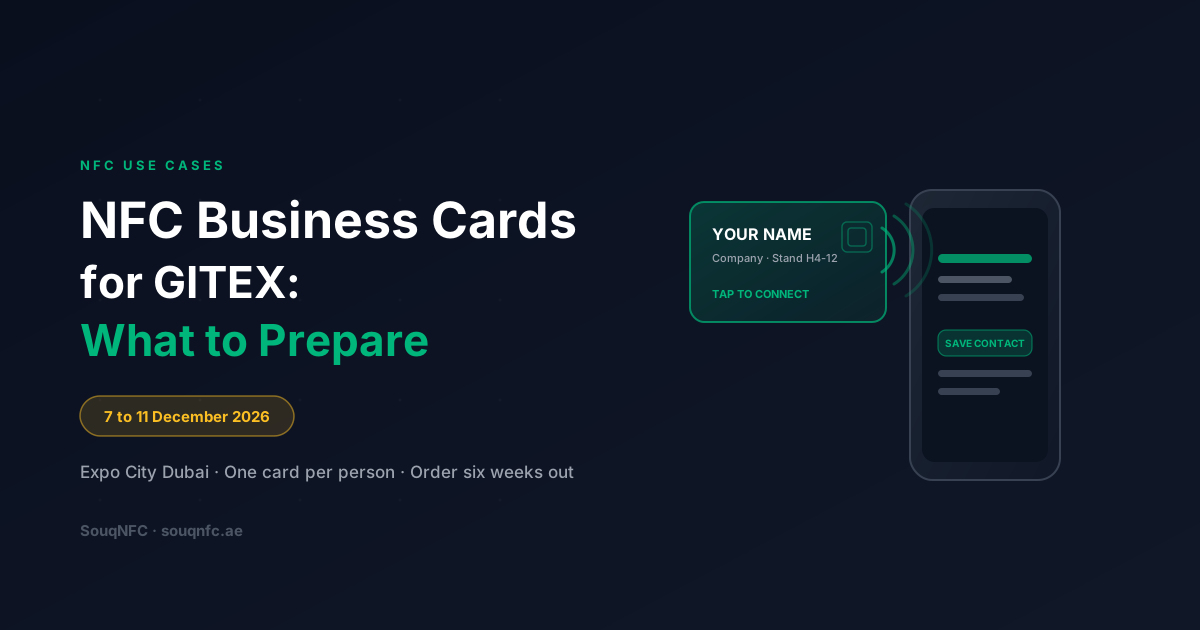
GITEX GLOBAL 2026 runs from 7 to 11 December 2026, with the main exhibition at Expo City Dubai from 8 to 11 December. The show has moved from its usual October slot at the Dubai World Trade Centre, so any preparation timeline you used for a previous edition is now wrong by about two months.
This change matters more than it first appears. Exhibitors who plan from memory will start their print and merchandise ordering in August, discover the show is in December, and relax. The risk is the opposite one: December places the ordering window squarely in the last quarter, when UAE suppliers are also handling year-end corporate gifting and every other exhibitor is ordering at the same time.
Confirm the dates, hall, and stand number on the official GITEX website before you commit to any print run, since venue and schedule details for an event of this size can still shift. Then work backwards from the first day you need the cards in hand, which is not the seventh of December. It is the week before, so that you can test them.
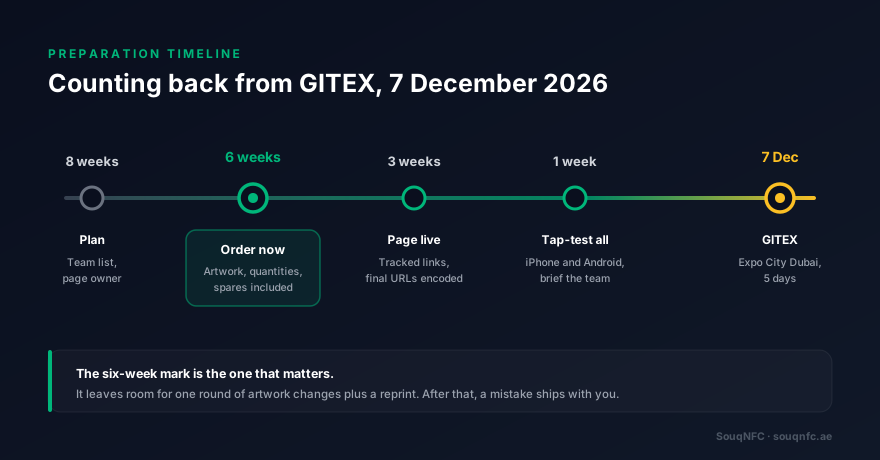
Six weeks is the number worth planning around. That covers artwork approval, production, encoding, delivery, and one full round of changes if the first proof is not right. Cards can be produced faster than that, and plenty of exhibitors order in the final fortnight, but a rushed order removes your ability to fix a mistake. A typo on a paper card is an annoyance. A wrong link encoded onto ninety cards is a show without a working lead capture.
How many cards does a stand team actually need?
One card per person, plus spares. This is the single biggest difference from paper, and the one that surprises finance teams: an NFC card is kept and reused, not given away, so a twelve-person stand needs about fifteen cards rather than three thousand.
NFC business cards invert the economics of a trade show giveaway. The visitor taps your card with their phone, your details land on their device, and your card goes back in your pocket ready for the next conversation. You are not buying volume, you are buying one durable object per person that survives five days of continuous use.
Order two or three spares beyond your headcount. Over a five-day show, cards get left on demo counters, walk off in a visitor's pocket after a tap they misunderstood, and occasionally snap. A spare in the stand drawer costs very little next to a senior salesperson spending day four without a card.
When you do want volume
There are two cases where higher quantities make sense. The first is a handout card: a cheaper PVC card you are happy to give away to serious prospects who want something physical to take. The second is a multi-brand group or a large corporate presence with several stands, where bulk NFC orders across the whole delegation are cheaper per unit than each division ordering separately. Consolidate before the show, not during it.
The third quantity question is the stand itself rather than the people on it. A tap point on the demo counter lets visitors take your details without waiting for a free salesperson, which matters during the mid-morning rush when your team is outnumbered. NFC table stands handle that, and NFC stickers can turn a demo unit, a brochure holder, or the stand fascia itself into a tap point. Keep these pointing at the same destination page as the team cards so you are not maintaining two things during a show week.
What should the card actually open?
A show-specific landing page you control, not a LinkedIn profile and not your homepage. This is the decision that determines whether GITEX produces a contact list or a pile of taps you cannot account for.
The card is a delivery mechanism. What it delivers is the part that earns or wastes the money. Three common choices, in ascending order of usefulness:
- 1.A LinkedIn profile. The weakest option. It drops the visitor into an app designed to keep them there, it may ask them to log in, and it tells you nothing about who tapped. You have handed a technology buyer to a social network at the exact moment they were interested in you.
- 2.Your homepage. Better, but it is built for a general audience. A visitor who just watched a two-minute demo lands on a page that says nothing about the demo, the show, or what to do next.
- 3.A GITEX landing page. Built for this show, live from the week before, and taken down or redirected in January. It knows why the visitor is there.
What belongs on that page
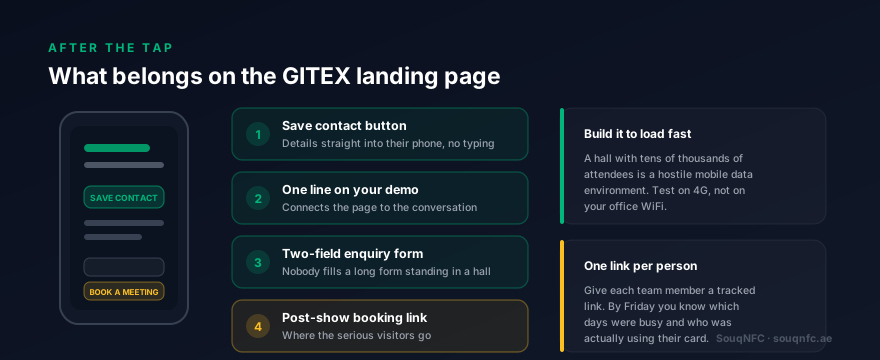
Keep it to four things. A save-contact button that writes your details straight into the visitor's phone. One line on what you are showing at the stand, so the page connects to the conversation they just had. A short enquiry form, two fields at most, because nobody fills in a long form standing in an exhibition hall. And a booking link for a meeting after the show, which is where the genuinely interested visitors go.
Make it load fast. A show floor with tens of thousands of attendees is a hostile mobile data environment, and a page that takes six seconds to appear will lose the visitor before it renders. Test it on mobile data rather than on your office WiFi.
Use a link that reports clicks, and give each team member a slightly different tracked link. At the end of the week you will know how many taps the stand produced, which days were busy, and which people on the team were actually using their cards. That last number is usually the uncomfortable one, and it is the one that tells you what to change next year.
What goes on the card itself?
Name, company, and a visible cue that the card is meant to be tapped. Most first-time buyers overload the card with details the phone is about to deliver anyway.
With custom NFC business cards, the temptation is to print everything: phone, email, website, office address, three social handles, a QR code, and a tagline. Resist it. The tap transfers all of that in under a second. What the printed surface needs to do is identify you and make the interaction obvious to someone who has never tapped a card before.
Include a small tap icon and two or three words of instruction near the antenna position. At a technology show you might assume this is unnecessary. In practice, a meaningful share of visitors at any show will hold the card against the middle of their phone rather than the top, get nothing, and quietly conclude your card is broken. The icon prevents that.
Material
Metal cards make sense for founders and senior sales staff, where the weight of the card is part of the impression, and they hold up better than PVC across a five-day show. They also cost several times more per unit. The usual split is metal for the people doing partnership and investor conversations, PVC for the wider stand team. If your budget only stretches one way, spend it on the destination page rather than the card material.
A note on chips
A URL fits comfortably on the smallest common chip, so chip memory is rarely the deciding factor for a card that points to a landing page. It matters more if you want the card to carry a full contact file directly rather than through a page. The breakdown of NFC chip types and data limits covers what each one holds, and NFC cards explained covers how the card is put together if this is your first order.
How do you use the card on the stand?
The tap is a closing move, not an opening one. Offer it at the end of a conversation that went somewhere, and let the visitor hold their own phone rather than reaching for it.
Agree one sentence across the team before the doors open. Something like “tap your phone here and you will have everything” while holding the card out at the top of their handset. Consistency matters because a stand where four people explain the card four different ways looks improvised.
Two practical points that come up constantly on show floors. First, never take a visitor's phone out of their hand: hold your card against the top of the device while they hold it. Second, if nothing happens on an Android handset, the likely cause is that NFC is switched off in settings rather than a fault with your card. Have a fallback ready for that case, whether a QR code printed on the back of the card or simply typing the short URL into their browser. The comparison of NFC and QR codes covers where each one earns its place, and a trade show is one of the clearest cases for carrying both.
Brief the team on what happens after the tap as well. If a visitor asks what the page will do with their details, someone on your stand should be able to answer that clearly. At a show full of data and AI companies, a vague answer to that question is noticed.
What happens after the show?
Follow up inside 48 hours. Everything you collected during the week is competing with everything every other exhibitor collected, and the follow-up window at a large show closes fast.
The advantage of running taps through a page you control is that your leads are already structured when the show ends. There is no stack of paper cards to transcribe, no evening spent photographing business cards into an app, and no gap between the last day and the first follow-up email. Export and send.
Sort by day before you write to anyone. A visitor you met on the first morning has had four more days of conversations since, and needs a different reminder of who you are than someone you spoke to on the final afternoon. Mentioning the specific demo they saw does more work than any amount of polish in the email.
Then keep the cards. The team cards do not expire with the show, and the same cards work at every meeting between now and the next one. If your business sits in Dubai Internet City or the surrounding technology campuses, the card that earned its cost over five days at GITEX goes on earning it through the year. Changing roles or rebranding means updating the destination page, not reprinting the cards.
The preparation checklist
Working back from 7 December 2026:
- ·Eight weeks out. Confirm the stand, the team list, and who is attending. Decide what the card opens and who is building that page.
- ·Six weeks out. Place the order. Artwork to the supplier, quantities confirmed, spares included. This is the point at which a problem is still cheap to fix.
- ·Three weeks out. Landing page live and tested on mobile data. Tracked links assigned per team member. Encoding confirmed against the final URLs.
- ·One week out. Cards in hand. Tap-test every single card on both an iPhone and an Android handset. Brief the team on the sentence and the fallback.
- ·Show week. Check the tap numbers each evening. If one day is far below the others, the problem is usually the briefing or the placement of the stand tap point, and both are fixable overnight.
- ·Within 48 hours of closing. Follow up, sorted by the day you met them.
If NFC is new to your team and you want the underlying explanation before specifying anything, the complete NFC guide for UAE businesses covers how the technology works and where it fits.
Frequently Asked Questions
When is GITEX GLOBAL 2026?
GITEX GLOBAL 2026 runs from 7 to 11 December 2026 in Dubai. The summit opens the week on 7 December and the main exhibition runs from 8 to 11 December at Expo City Dubai. This is a change from previous editions, which were held in October at the Dubai World Trade Centre, so check the official GITEX website for the current schedule and hall plan before you book anything.
How far in advance should I order NFC business cards for GITEX?
Aim for about six weeks before the show. Custom printed cards involve artwork approval, production, and encoding, and six weeks leaves room for one round of artwork changes plus a reprint if something is wrong. Ordering in the final fortnight is possible with many suppliers, but it removes your margin for error, and the week before GITEX is the busiest period of the year for UAE print and NFC suppliers.
How many NFC business cards does a GITEX team need?
Unlike paper cards, an NFC card is not given away, so you need one per team member rather than hundreds. Order one card per person on the stand plus two or three spares, since cards get lost, walk off in a visitor pocket, or get damaged during a five-day show. Teams that also want to hand something over physically usually order a small batch of cheaper handout cards alongside the reusable team cards.
Will NFC cards work on the show floor with thousands of people around?
Yes. NFC works over a range of a few centimetres and is not affected by crowding, WiFi congestion, or mobile network load in the way that some other technologies are. The one thing that does depend on the network is the page that opens after the tap, so build a lightweight destination page that loads quickly on a congested mobile connection.
Should the card link to LinkedIn or to our own page?
Your own page, in almost every case. LinkedIn sends the visitor into an app full of distractions, may prompt them to log in, and gives you no way to capture the lead or measure the tap. A page you control can save your contact details, show what you are demonstrating at the show, and capture an enquiry, and you can change it between days if something is not working.
Do visitors need an app to tap an NFC business card?
No. Every iPhone from the XS onward and effectively every modern Android handset reads NFC tags natively with nothing installed. On iPhone the reader is always on when the screen is unlocked. Some older Android devices require NFC to be switched on in settings, which is the most common reason a tap does not register.
Are metal NFC cards a good idea for a trade show?
They work well for a small senior team where the card itself is part of the impression you want to make, and they survive a five-day show better than PVC. They cost considerably more per unit, so most exhibitors order metal cards for founders and senior sales staff and PVC cards for the wider stand team.
Exhibiting at GITEX?
SouqNFC supplies NFC cards to Dubai exhibitors
Custom branded NFC business cards in PVC and metal, encoded to your landing page, with team pricing and delivery across the UAE. Order early to keep your margin for changes.
Get a quote